
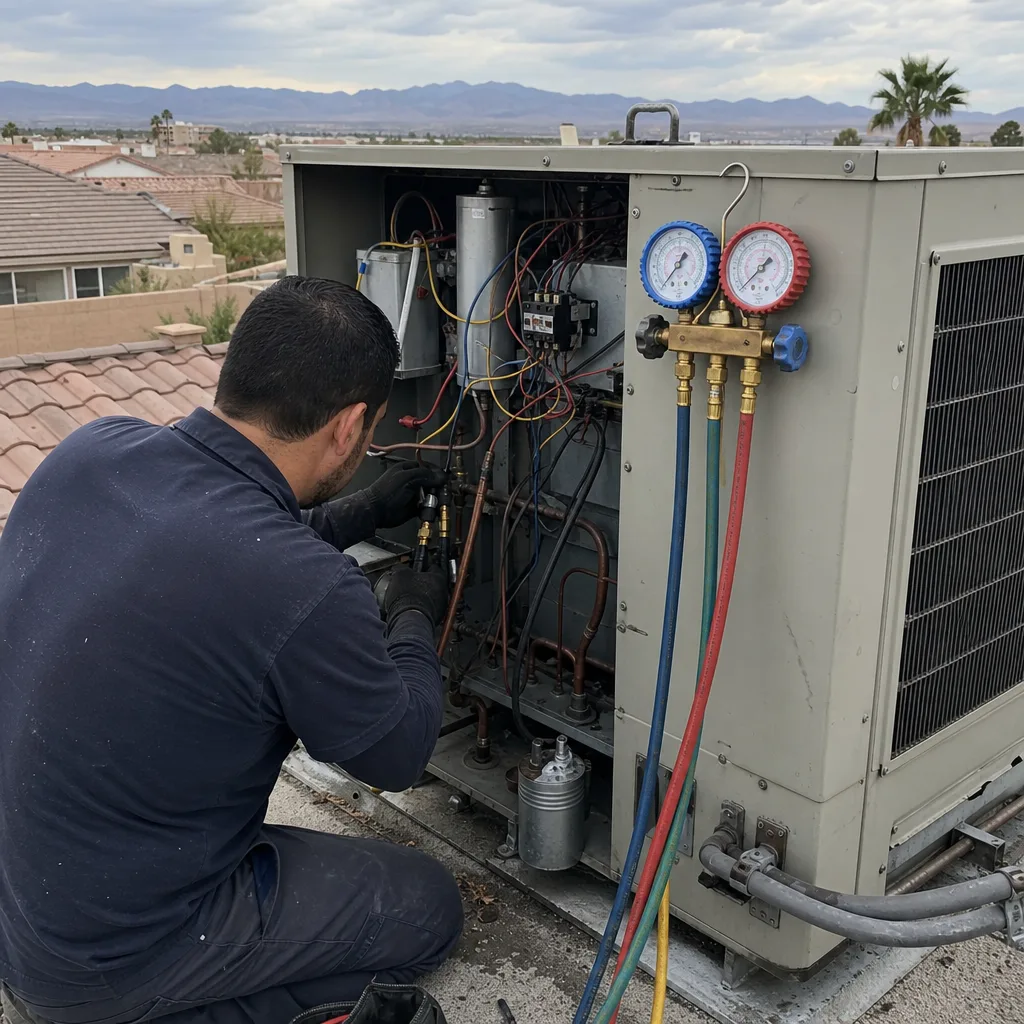
Last updated October 16, 2026
 AC repair
 Furnace & heating
 Heat pumps
 Ductless mini splits
 Carrier
 Trane
Trane Goodman
Seasonal tune-up and full diagnostic on your Carrier, Trane, or Goodman system - readings shown to you before any repair is proposed
Diagnosis first, numbers second - you approve the repair price before a single part goes in.
Get your free estimateHVAC Permits, Codes & Inspections in NV: What You Need to Know
If an HVAC contractor tells you “we don’t need a permit for a straight swap,” that’s either ignorance or a shortcut, and either way, you’re the one who owns the liability when you sell the house. In Las Vegas, where summer temperatures routinely cross 110 degrees, a properly permitted HVAC installation isn’t just paperwork. It’s the difference between a system that cools your home safely for 15 years and one that fails in August, voids its manufacturer warranty, and surfaces as a red flag during escrow. This guide explains exactly which HVAC projects require a permit in Nevada, what an inspector actually checks, and how to confirm your contractor did the job right before you hand over a final payment. For related reading, see our HVAC Warning Signs: A Las Vegas Homeowner’s Reference Guide.
Quick Answer
Most HVAC replacements, new installations, and ductwork changes in Las Vegas require a mechanical permit from Clark County or the City of Las Vegas, depending on your address. Our Seasonal HVAC Care for Las Vegas: Year-Round Homeowner’s Guide covers when to schedule this work. The permit triggers a code inspection that verifies the equipment was sized correctly and installed safely. Unpermitted HVAC work does not simply disappear: Nevada disclosure laws require you to reveal known unpermitted improvements when you sell, and buyers’ inspectors routinely catch permits that were never pulled. Budget $150 to $500 for the permit itself, plus the contractor’s time for the inspection visit.
Styles & brands we work with
Table of Contents
- Which HVAC Projects Require a Permit in Las Vegas
- What the Nevada Mechanical Code Actually Governs
- What an HVAC Inspector Actually Checks During a Rough and Final Inspection
- How to Confirm Your Contractor Pulled a Permit Before Work Starts
- What Unpermitted HVAC Work Does to a Home Sale
- What a Passing Inspection Actually Certifies, and What It Doesn’t
- How Much HVAC Permits Cost in Clark County and Las Vegas
- Common Mistakes to Avoid
- When to Call a Professional
- Frequently Asked Questions
Which HVAC Projects Require a Permit in Las Vegas
Clark County and the City of Las Vegas both use the Uniform Mechanical Code as the baseline, with local amendments that tighten requirements for our desert climate. Here’s what actually triggers a permit in the Las Vegas valley.
Projects that require a mechanical permit:
- Full HVAC system replacement – A new condenser outside and a new air handler or furnace inside. This is always permit-required, regardless of whether the equipment goes in the same spot.
- New HVAC system installation – Adding central air or heat to a home that never had it. This requires a permit plus electrical and possibly gas line work.
- Furnace replacement or conversion – Swapping a furnace or converting from electric to gas heat. Gas line connections are inspected separately in many cases.
- Ductwork installation or major modification – Replacing more than a short section of duct, adding new supply runs, or reconfiguring returns.
- Relocating equipment – Moving a condenser, air handler, or furnace to a different location on the property.
Projects that are generally exempt from permits:
- Replacing a capacitor, contactor, thermostat, or circuit board on an existing system
- Cleaning coils, clearing a clogged condensate drain, or recharging refrigerant on a functioning unit
- Replacing a blower motor or fan blade within the existing housing
- Minor duct repairs under a few feet, such as patching a disconnected boot
- Annual maintenance and tune-ups, including filter changes and coil cleaning
The line between repair and replacement matters. If the scope of work changes mid-job – say a simple compressor swap becomes a full condenser replacement – the permit requirement kicks in then and there. We have seen Las Vegas homeowners told by contractors that “it’s just a repair” when the outdoor unit sitting in their driveway is clearly a full replacement. That’s the moment to stop the work and demand the pulled permit. When we handle AC repair in Las Vegas, we flag the permit threshold before any equipment arrives.
What the Nevada Mechanical Code Actually Governs
Nevada adopted the Uniform Mechanical Code as its statewide baseline, and Clark County and the City of Las Vegas enforce it with local amendments. The code isn’t a suggestion sheet. It sets binding rules for how HVAC equipment is sized, how ducts are designed, how refrigerant is handled, and how electrical and gas connections are made.
Here’s what the code governs, in plain terms:
- Equipment sizing – The code requires a load calculation (Manual J is the industry standard) to match equipment capacity to the home’s square footage, orientation, window area, and insulation levels. Oversized units in Las Vegas are a recurring problem: they short-cycle, fail to dehumidify, and wear out compressors years early. An inspector may ask to see the load calc.
- Duct design and sealing – The code sets minimum standards for duct sizing and sealing. Leaky ducts in a Las Vegas attic can waste 25 to 40 percent of conditioned air. The inspector checks for proper support, insulation R-value on supply ducts, and sealed connections.
- Refrigerant handling – EPA Section 608 rules apply here: only certified technicians may handle refrigerants, and the code requires proper recovery of old refrigerant and leak checks on new installations. Venting refrigerant to the atmosphere is a federal violation, not a code footnote.
- Clearance and access – The code specifies minimum clearances around outdoor condensers for airflow and service access. It also requires a disconnect switch within reach of the unit and proper electrical grounding.
- Combustion safety – For gas furnaces, the code covers venting, combustion air supply, and gas piping pressure testing. In a tightly sealed Las Vegas home, improper combustion air can create a carbon monoxide backdraft risk.
- Condensate drainage – The code sets the slope and termination point for condensate lines. In Las Vegas, where evaporated cooler retrofits and AC systems often share roof penetrations, improper drainage causes water damage and mold.
Most homeowners never read the Uniform Mechanical Code. They don’t need to. But they do need to know that the code exists and that a contractor who waves it off as “just bureaucracy” is ignoring the standards that protect your health and your home’s structure. We service furnaces throughout Las Vegas, and we see plenty of code violations that were originally installed by someone who thought an inspection wouldn’t matter.
What an HVAC Inspector Actually Checks During a Rough and Final Inspection
An HVAC permit in Las Vegas typically involves two inspections: a rough inspection while the work is in progress, and a final inspection after everything is connected and running. Knowing what the inspector looks for helps you understand why cutting corners gets caught.
Rough inspection (mid-installation):
- The inspector checks that the equipment being installed matches the equipment listed on the permit application, including brand, model, and capacity.
- For new ductwork, the inspector verifies duct sizing matches the design, seams are sealed with mastic or approved tape, and ducts are supported at the required intervals.
- For gas lines, the inspector may require a pressure test with the gas held at a specific pressure for a set time to confirm no leaks.
- The inspector verifies that electrical disconnects are installed within reach of the equipment and that wiring gauge matches the equipment’s amp draw.
- Clearances around the condenser are checked against code minimums for airflow and service access.
Final inspection (after startup):
- The inspector confirms the system starts and runs through its sequence of operation. For a furnace, that means the inducer, igniter, and gas valve all fire correctly. For an AC, the condenser and blower run and the thermostat cycles the system.
- Refrigerant line insulation is checked, especially on the suction line, where exposed copper in a Las Vegas attic loses efficiency fast.
- Condensate drainage is tested by pouring water into the drain pan and confirming it flows to the termination point.
- The inspector validates that the thermostat is wired and programmed to control the equipment, not bypassed or jumpered.
- If the permit included new electrical or gas work, the inspector signs off on those disciplines at the same time or coordinates with separate electrical and plumbing inspectors.
The inspection isn’t a performance test of the equipment’s efficiency. It’s a code-compliance check. The inspector cares whether the installation is safe and code-correct. Whether the system was sized perfectly for your home’s heat load, whether the duct design delivers balanced airflow to every room, and whether the installer used best practices beyond the code minimum – those are quality questions the inspector doesn’t adjudicate. That’s why a passing inspection is the floor, not the ceiling.
For homeowners in Las Vegas, the rough inspection is also the moment a bad installation gets caught before drywall or roofing hides it. If the inspector flags a duct sizing problem or a clearance violation, the contractor corrects it and calls for a reinspection. That reinspection fee is the contractor’s burden, not the homeowner’s, assuming the contractor pulled the permit correctly.
How to Confirm Your Contractor Pulled a Permit Before Work Starts
Contractors sometimes tell a Las Vegas homeowner the permit is “being processed” or “will be finalized after the job.” Here’s how to verify the truth before the first piece of equipment arrives at your house.
- Ask for the permit number in writing. A legitimate contractor has the permit number the moment they submit the application. It’s formatted like BK-2024-12345 in Clark County. If they can’t produce a number, they haven’t pulled a permit.
- Look up the address on the Clark County building department’s online permit portal. Clark County has a public search tool where you can enter your address and see all active and recently issued permits. The City of Las Vegas has its own portal for addresses in the city limits. Check both, because your address belongs to one or the other.
- Confirm the permit type matches the work. The permit should be listed as a mechanical permit, sometimes called an HVAC permit or an M permit. If you see only an electrical permit for a full HVAC replacement, ask why the mechanical permit isn’t there.
- Match the contractor’s name to the permit holder. The permit should be pulled in the name of the licensed contractor doing the work. If a subcontractor’s name appears and you never agreed to a subcontractor, that’s a red flag about who actually carries the liability.
- Check the permit status after the final inspection. A permit that shows “issued” but not “finaled” means the inspection never happened or failed. An open permit is a lien on your home’s building record and will surface during a title search when you sell.
This five-minute check protects you from the classic Las Vegas shell game: a contractor who quotes a low price by omitting the permit, starts the work, and only then tells you the permit “wasn’t on the quote.” The work proceeds anyway because the equipment is already on your roof or pad, and you’re stuck either paying the permit fee retroactively or living with unpermitted equipment. We believe every Las Vegas homeowner deserves to know the permit status before work begins, not after. When we handle AC maintenance for Las Vegas homes, we proactively share permit documentation for any work that crosses the threshold, because a homeowner who understands their permit status is a homeowner who can hold any contractor accountable.
What Unpermitted HVAC Work Does to a Home Sale
Nevada law requires home sellers to complete a Seller’s Real Property Disclosure form. One of the questions asks whether the seller is aware of any improvements or alterations made without required permits. If an HVAC system was replaced without a permit and you know it, you have a legal obligation to disclose it. Failing to disclose opens you to a post-closing lawsuit from the buyer.
Here’s how unpermitted HVAC work surfaces during a sale, even when the seller stays quiet:
- The buyer’s home inspector checks the permit history. A standard home inspection in Las Vegas includes comparing the visible equipment’s age and condition against the county permit record. A 2022-era condenser with no corresponding 2022 mechanical permit is an immediate red flag. The inspector documents it in the report.
- The buyer’s lender may flag it. An FHA appraisal requires that mechanical systems be functional. Some appraisers note unpermitted additions and require cure-before-closing conditions. VA loans carry similar expectations for the home’s mechanical condition. Conventional loans leave it to the appraiser’s discretion, but a glaring discrepancy between equipment age and permit history can stall underwriting.
- Title companies see open permits. If a permit was pulled but never finaled, the open permit appears on the property’s record during the title search. The title company may require resolution before issuing a policy. A finaled permit is clean. An open one is a delay.
- Insurance companies may deny claims. Home insurance policies typically require that mechanical systems be installed per code. If a fire starts in an unpermitted furnace installation, the insurer may deny the claim based on the non-permitted work, even if the fire’s origin isn’t the HVAC system. Insurers use permit history when investigating claims.
- Home warranty companies reject the claim. When a buyer purchases a home warranty and submits an AC claim in month two, the warranty company checks for permits. No permit, no coverage. The buyer then turns to the seller for the repair cost.
The dollar risk is real. A Las Vegas home sale in Summerlin or Henderson can involve a $60,000-plus cost to the seller if an unpermitted HVAC system causes the deal to collapse or triggers a seller credit. And the buyer’s leverage is simple: they know you disclosed or should have disclosed, and they know what a retrofit permit costs after the fact. In our experience, the homeowners who get hurt most are the ones who never knew the permit was missing in the first place. They trusted a contractor, and the contractor’s shortcut became their problem at the closing table.
What a Passing Inspection Actually Certifies, and What It Doesn’t
A passing final inspection certifies that the installed HVAC system meets the minimum requirements of the Uniform Mechanical Code as adopted by Clark County or the City of Las Vegas. That means the equipment is wired correctly, the gas line holds pressure, the condensate drains, and the electrical disconnect is where it belongs. It means a code enforcement officer saw the system and put a signature on the permit.
What a passing inspection does not certify:
- It does not certify that the system was sized correctly. The inspector may glance at the load calculation, but they don’t re-run the Manual J. A five-ton condenser on a 1,600-square-foot home may pass inspection while being badly oversized for the space.
- It does not certify that the duct design delivers balanced airflow. The inspector checks duct sizing and sealing against code minimums, but code minimums don’t guarantee even temperatures in every bedroom. That’s a design and commissioning question.
- It does not certify that the refrigerant charge is dialed in. The inspector may check that the system runs, but superheat and subcooling numbers are outside the inspection scope. An overcharged or undercharged system can pass inspection and deliver poor performance.
- It does not certify workmanship beyond the code minimum. Neatly run line sets, properly supported ductwork, well-executed flashing on roof penetrations – these are quality distinctions the inspector doesn’t score.
- It does not certify that the contractor tested static pressure or verified airflow CFM. Those commissioning steps catch duct restrictions and undersized returns. They are best practices, not code requirements.
This is why smart Las Vegas homeowners treat the permit and inspection as the baseline, then ask their contractor to commission the system properly. Commissioning means testing static pressure, adjusting airflow to the design CFM, verifying the refrigerant charge, and documenting the startup numbers. At Brandt HVAC Co Las Vegas, we document startup readings on every new installation because a system that meets code and a system that performs well are not the same thing. See our AC Repair Maintenance Checklist for Las Vegas Homeowners for what to track. The code gives you a safe installation. Commissioning gives you the performance you paid for.
How Much HVAC Permits Cost in Clark County and Las Vegas
Permit fees in the Las Vegas valley vary by jurisdiction and project valuation, but here’s a realistic range based on typical residential HVAC work.
- Straight AC or furnace replacement: The permit fee usually runs $150 to $350, depending on the equipment valuation and the jurisdiction. Clark County bases its fee on the total project valuation in tiers, so a two-stage high-efficiency Rheem system costs slightly more in permit fees than a base-model York.
- New HVAC systems or major ductwork: Plan on $250 to $600 in permit fees. Ductwork adds to the valuation, and some jurisdictions charge separately for the mechanical and electrical portions of the work.
- Gas furnace replacement with new gas lines: The mechanical permit plus the gas line inspection can run $200 to $500. Some jurisdictions fold the gas pressure test into the mechanical permit.
- Retroactive permits for unpermitted work: These cost substantially more, often double or triple the original fee, plus the cost of opening walls, ceilings, or equipment access for the inspector to see the work. Retroactive permits in Las Vegas can run $500 to $1,500 in fees alone.
The permit fee is separate from the contractor’s labor and materials. A reputable contractor line-items the permit fee on the proposal, and that’s exactly what you want. A proposal that says “permit fees included” is fine, as long as the permit number is provided before work starts. If a contractor buries the permit cost or waves it off entirely, that’s the signal to ask harder questions.
For a Daikin or Bryant system installed in a Las Vegas home, the permit cost is typically under 3 percent of the total project cost. That’s a small price for the legal protection of a finaled permit and the insurance and warranty coverage that follows it.
Common Mistakes to Avoid
- Believing “we don’t need a permit for a swap.” In Clark County and the City of Las Vegas, replacing an entire HVAC system always requires a permit. Any contractor who says otherwise is either misinformed or hoping you don’t verify.
- Paying the final invoice before the final inspection. The final payment should be tied to the final inspection sign-off, not to the day the equipment starts running. A contractor who collects full payment before the inspection has the inspector’s signature has little reason to fix a failed inspection quickly.
- Assuming the home inspector will catch unpermitted work before you buy. Home inspectors check equipment condition, and some check permit history, but the burden falls on you and your agent to pull the permit record. Don’t assume a home inspection includes a permit audit.
- Accepting a “cheaper price without the permit.” The savings evaporate at resale, during an insurance claim, or when the next buyer’s inspector flags the system. The permit is not negotiable, and the contractor who suggests it is negotiating away your legal protection.
- Never checking the permit status ourselves. Las Vegas homeowners can look up their address on the county or city portal in under five minutes. It’s the single most effective verification step available, and almost nobody does it.
- Confusing a passing inspection with a quality installation. Code compliance is the minimum. Proper sizing, duct design, refrigerant charge, and startup commissioning are separate quality questions. Ask your contractor for the startup report, not just the inspection sign-off.
- Letting a contractor use an unlicensed subcontractor for the permit work. The permit should carry the licensed contractor’s name and license number. If a subcontractor’s name appears and you didn’t agree to one, stop the work and get clarity on who is legally responsible for the installation.
When to Call a Professional
You should call a licensed HVAC contractor any time the work involves refrigerant, gas lines, electrical disconnects, or ductwork beyond a simple patch. These are not weekend projects. The risks include high-voltage exposure, refrigerant burns, gas leaks, and carbon monoxide dangers. A licensed professional carries the insurance, the training, and the permit accountability that a homeowner simply can’t replicate. If you’re in Las Vegas and you’re planning an HVAC replacement, a new installation, or any project that will require a permit, start with an estimate that line-items the permit fee and names the jurisdiction that will inspect the work. Brandt HVAC Co Las Vegas offers free estimates in Las Vegas – call (725) 502-1353 and we’ll walk you through exactly what your project will cost, what the permit covers, and who will be showing up at your door.
Frequently Asked Questions
Yes, in Clark County and the City of Las Vegas, a full AC replacement requires a mechanical permit. The permit triggers a rough and final inspection that verifies the electrical disconnect, refrigerant line insulation, condensate drainage, and equipment clearances meet the Uniform Mechanical Code. Repairs like capacitor or thermostat replacements are exempt, but a complete condenser and air handler swap is never exempt. Call (725) 502-1353 if you want us to check the permit requirements for your specific project – estimates are free.
Most residential HVAC permits in Las Vegas run $150 to $350 for a straight replacement, and $250 to $600 when ductwork or new gas lines are involved. The fee is based on the project valuation and the jurisdiction, with Clark County and the City of Las Vegas each setting their own fee schedule. Retroactive permits for unpermitted work cost substantially more. A reputable contractor line-items the permit fee on your proposal. Call (725) 502-1353 for an exact permit cost on your project.
Nevada’s Seller’s Real Property Disclosure form requires you to disclose known unpermitted improvements. If you don’t and the buyer’s inspector or title company finds the discrepancy, you can face legal exposure, a collapsed sale, or a significant seller credit. The buyer’s lender may also flag unpermitted work and stall closing. Many Las Vegas home sales are delayed or renegotiated over unpermitted HVAC systems that the seller never knew were unpermitted. Call (725) 502-1353 and we’ll help you verify your system’s permit history before you list.
In Nevada, homeowners may pull permits for work on their own primary residence under an owner-builder exemption, but HVAC work is the wrong place to exercise that right. The Uniform Mechanical Code requires load calculations, refrigerant handling certifications, and gas line pressure testing that take trade training to execute correctly. Most Las Vegas homeowners who pull their own HVAC permit end up hiring a contractor to fix the work anyway, and the liability for the installation remains tied to the owner-builder permit. A licensed contractor pulling the permit carries that liability for you.
No, home warranty companies routinely deny claims for HVAC systems installed without a permit. The warranty company’s adjuster checks the permit record when you submit a claim, and an unpermitted installation gives them a clean denial. The same holds for homeowner’s insurance if an unpermitted furnace or AC unit contributes to a damage claim. A finaled permit is your evidence that a licensed contractor did the job to code.
A code inspection confirms the installation meets the minimum requirements of the Uniform Mechanical Code: safe wiring, proper gas connections, adequate clearances, and working drainage. A commissioning report goes further: it documents static pressure, airflow CFM, refrigerant charge, and temperature split to confirm the system performs as designed. Both matter. A system can pass inspection while being badly oversized or undercharged. Ask your contractor for the commissioning report on a new Rheem or York system, not just the inspection sign-off.
The Bottom Line
Permits for HVAC work in Las Vegas are not a luxury or an optional upsell. They are the legal record that your equipment was installed to code, and they protect you at resale, during insurance claims, and in warranty disputes. The permit process is straightforward when a licensed contractor handles it correctly: application, rough inspection, final inspection, final payment. The danger comes from contractors who quietly skip the permit, and from homeowners who never think to check. Before you sign an HVAC contract in Las Vegas, confirm the permit number exists, look it up by address, and tie your final payment to the final inspection sign-off. That’s how you protect your home, your money, and your next sale. And for any HVAC project in Las Vegas, call (725) 502-1353 for a free estimate – we’ll quote the permit fee line-by-line and walk you through exactly what to expect. Visit our more guides & resources page for additional homeowner help.
Written by Devin Marlowe, Owner at Brandt HVAC Co Las Vegas, serving Las Vegas since 2003.
See the difference
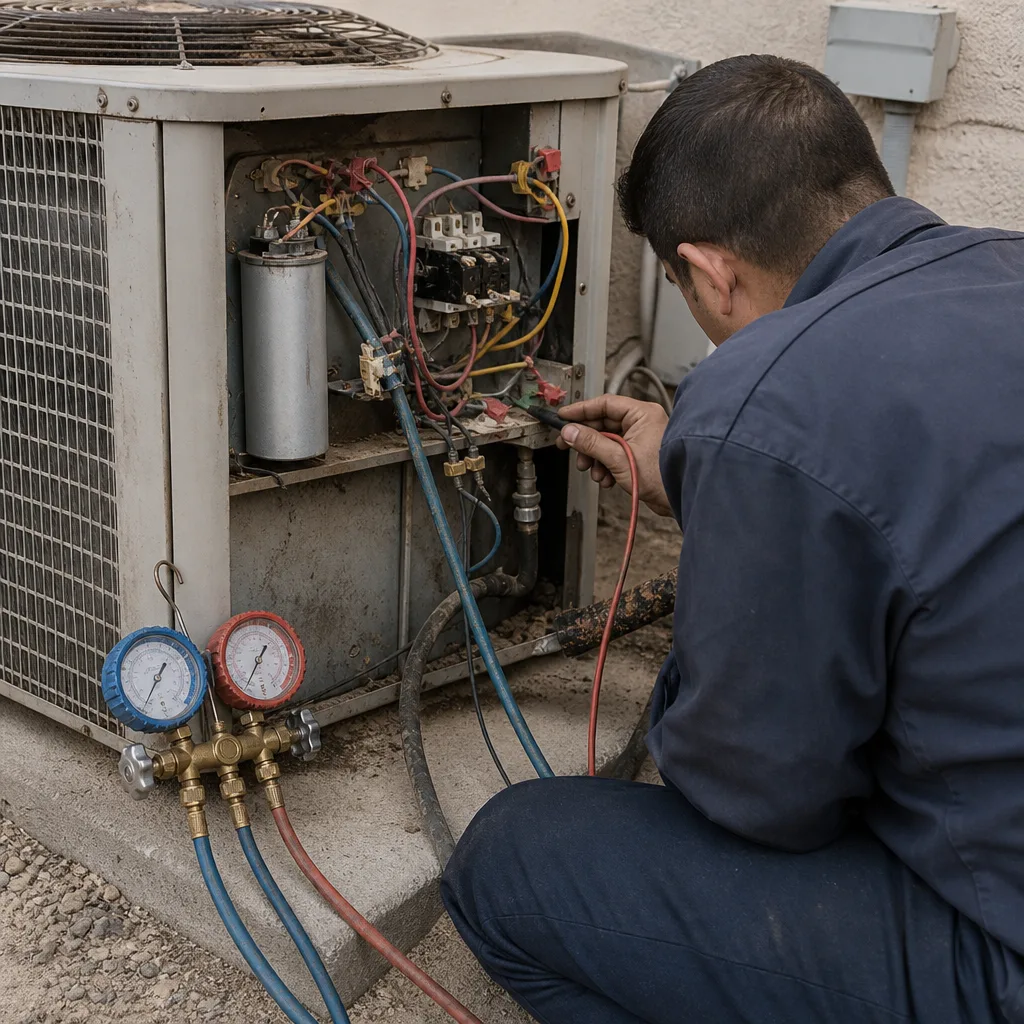 Before
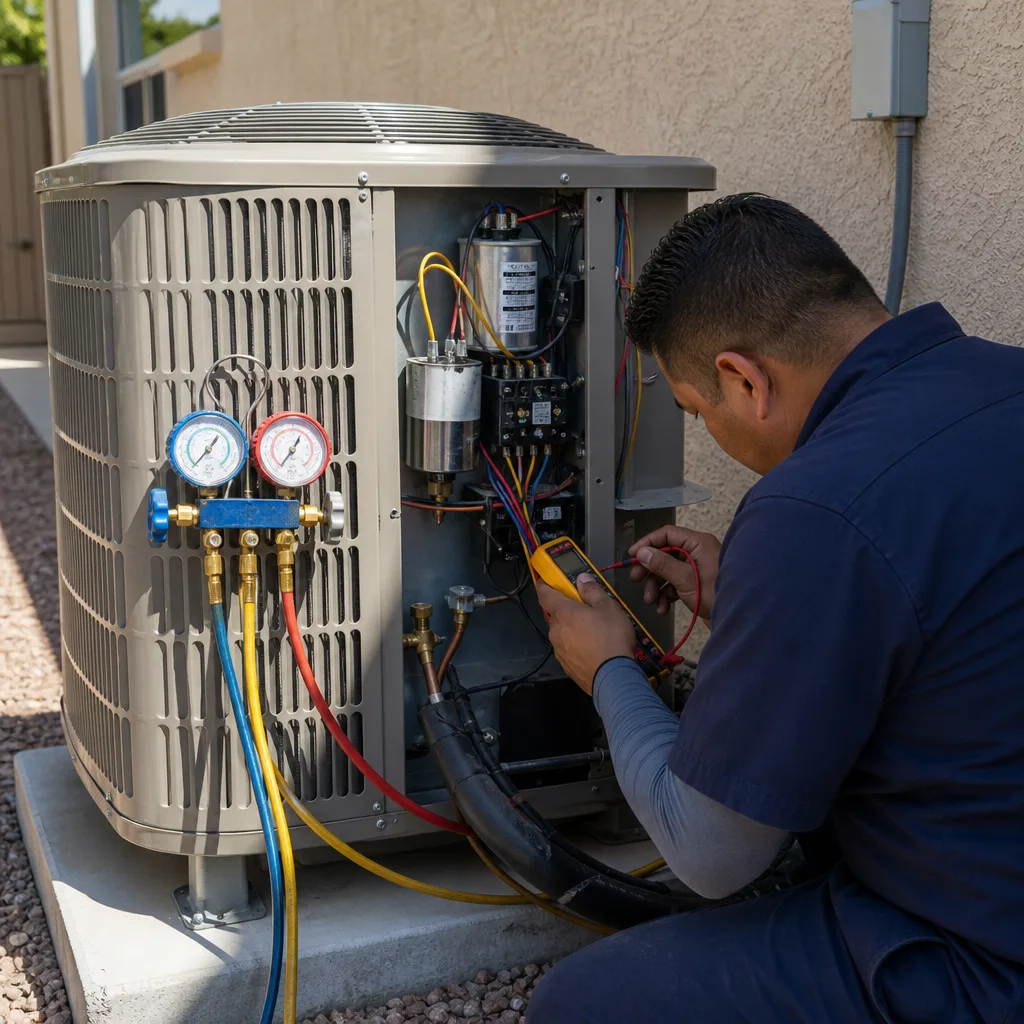 After
After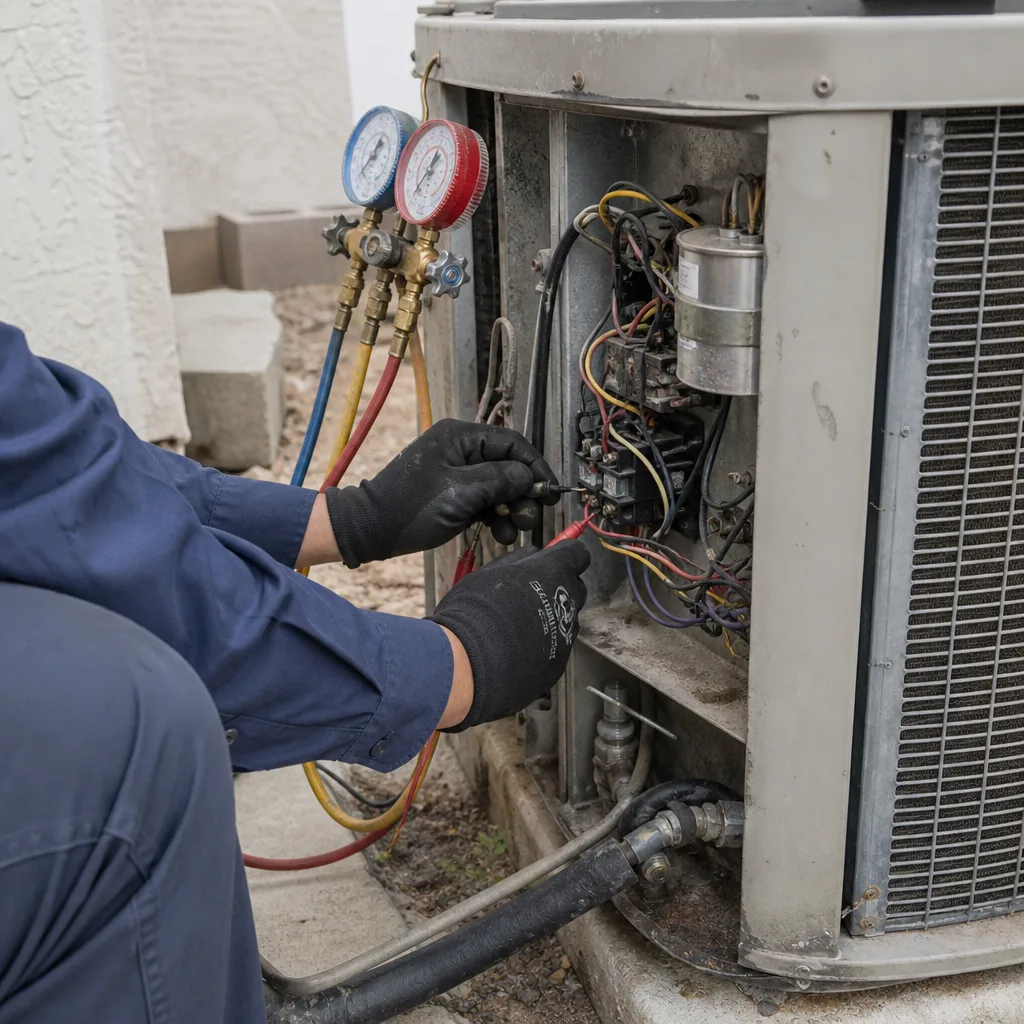 Before
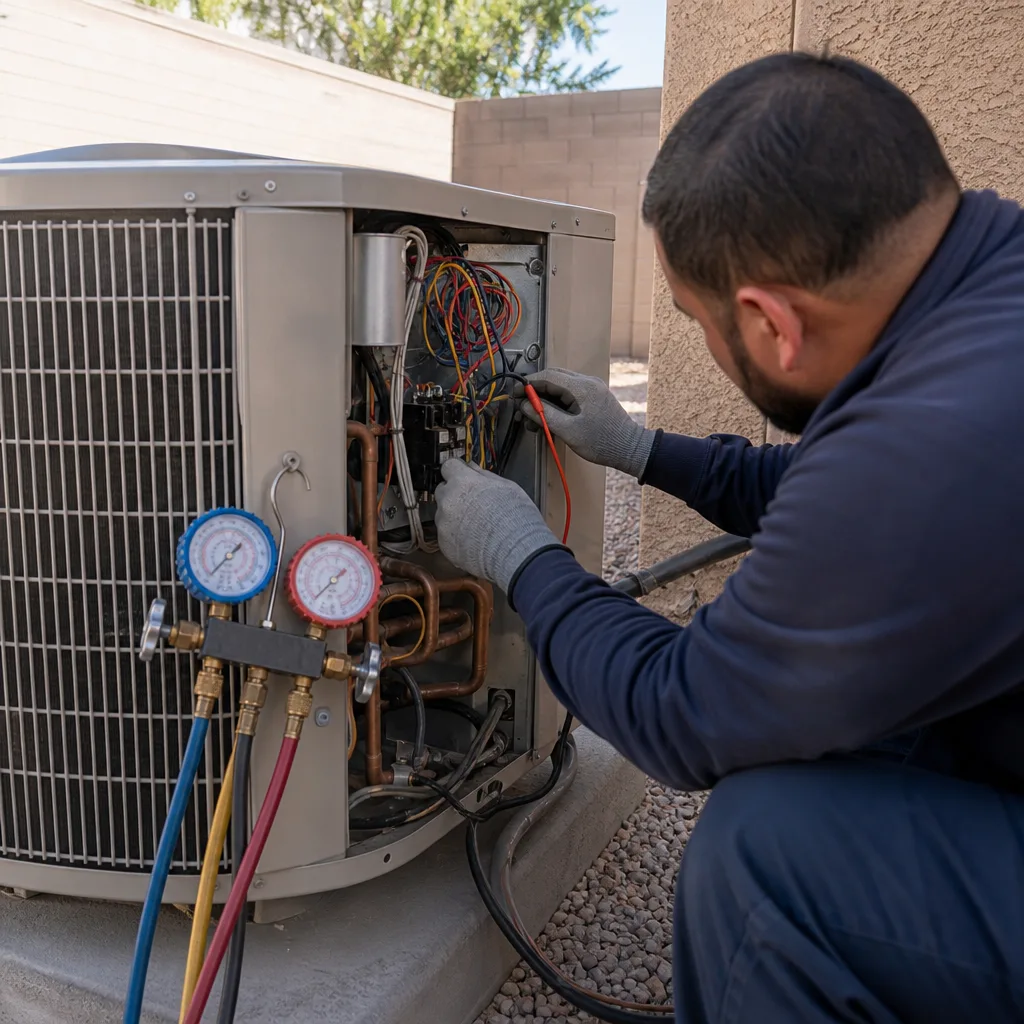 After
After Before
 After
After